


By the time a prospect asks for a call, they may already have an opinion about your business. They have read your website, compared your explanation with someone else's, or forwarded an article to a colleague. Your sales team sees the enquiry. It rarely sees every conversation that led to it.
That is one reason content marketing matters for B2B companies. It gives buyers a way to understand your thinking before they commit time to a meeting. A useful article can clarify a problem. A demonstration can make an unfamiliar process easier to evaluate. A thoughtful comparison can help someone decide whether your approach fits their situation.
The goal is to give a relevant buyer a reason to consider you, and enough substance to take that consideration further.
Buyers arrive with opinions already formed
In its 2025 B2B Buyer Experience Report, 6sense found that 94% of buying groups ranked their shortlist before speaking with sellers. Its sample covered substantial purchases, with a minimum qualifying spend of $25,000, so the figure should not be treated as a rule for every business purchase.
It does, however, offer a useful reminder: the buying process begins before your sales process does.
The study does not establish that content creates vendor preference by itself. Previous experience, recommendations and the product all matter. Content gives your business something helpful to contribute while that preference is forming.
Consider an illustrative example. An operations manager wants to replace a reporting process built around spreadsheets. An article explaining when spreadsheets become difficult to govern may help them define the problem. A guide to migration questions can help them evaluate options. A clear description of your implementation process can help them judge whether to contact you.
Each piece answers a different question. Together, they make the next conversation more informed.
Explain the work behind your claims
Almost any company can describe itself as experienced, innovative or customer-focused. Those claims give a buyer little to inspect.
A better article shows how you think. If you provide a service, explain the decisions that shape delivery. If you sell a technical product, demonstrate how it works under realistic conditions. If an approach has limitations, describe where those limitations become relevant.
For a B2B content programme, that might mean explaining why a long report needs a different structure when adapted into a short video. The written report can build an argument gradually. The video has to establish context quickly and focus on a point that can survive the shorter format.
Showing that decision is more useful than describing the output as “engaging content.” Readers can assess the reasoning and decide whether they agree with it.
This also gives smaller businesses a practical starting point. You may not have a library of published research or a long list of case studies. You can still document a real process, answer a difficult question, or explain a tradeoff accurately. Use evidence you have permission to share, and distinguish an illustrative example from an actual customer result.
Write for the colleague who receives the link
The person reading your article may need to explain the purchase to someone else. That changes what useful content looks like.
The 2025 Edelman–LinkedIn research examines less-visible stakeholders who influence B2B decisions. It reports that 55% of these “hidden buyers” use thought leadership as part of vendor evaluation. Their concerns may include the operational or financial implications of a decision, even when they will not use the product themselves.
Our practical recommendation is to make your content easy to share and understand without a salesperson narrating it. Define unfamiliar terms. Explain what has to change inside the customer's business. Include the questions a colleague is likely to ask.
For example, a guide to outsourcing content might help a marketing manager assess creative quality. It should also explain what the internal approver needs to supply, how factual review works, and which activities are outside the delivery scope. Those details help the idea travel through the business with less guesswork.
Match content to a decision
Start a content plan with the questions your audience is trying to resolve. Search terms can help you understand how people phrase those questions, but a keyword alone is not a complete brief.
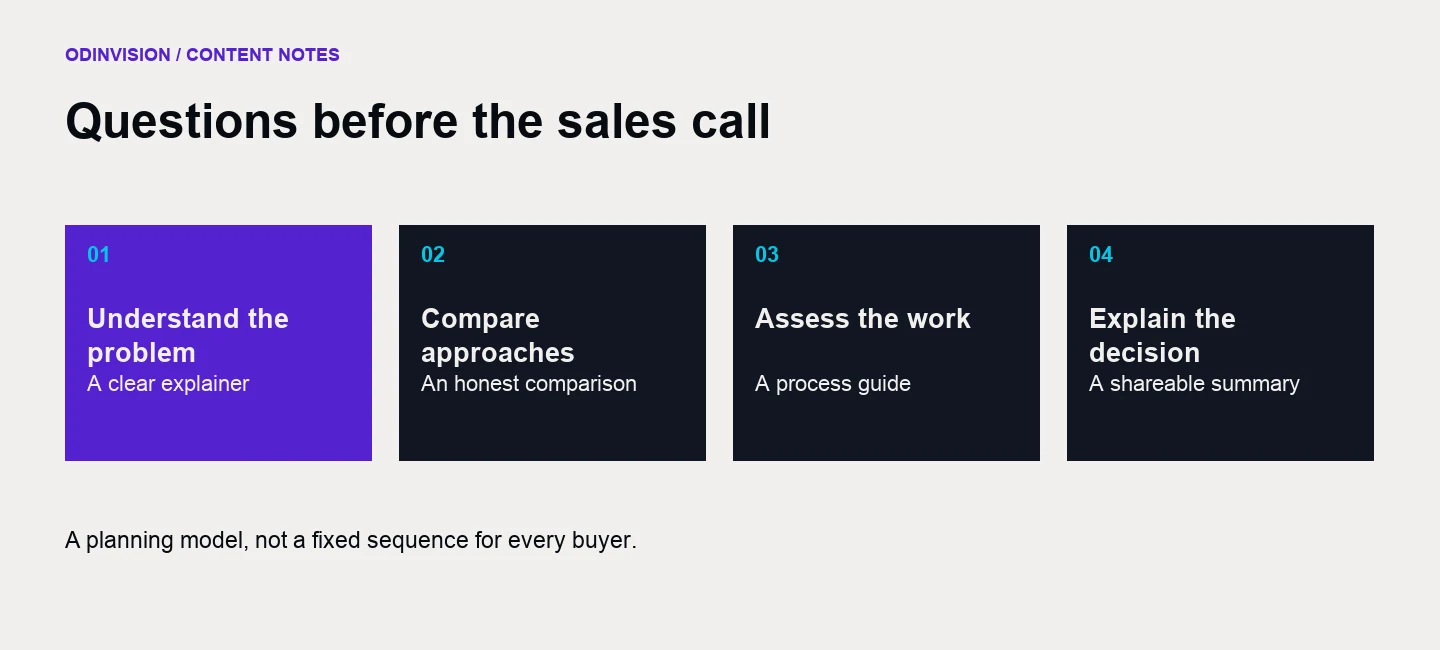
Imagine a business exploring a more consistent marketing programme. Its questions might develop like this:
| Buyer question | Useful content response |
|---|---|
| Why does our marketing keep stopping and starting? | An explanation of common planning and approval bottlenecks |
| Should we produce content internally or use a partner? | A comparison of responsibilities, capabilities and tradeoffs |
| What would our team need to contribute? | A practical account of inputs, review and ownership |
| How will we judge whether it is working? | A guide linking content goals to observable outcomes |
This is a planning model, not a claim that everyone buys in a tidy sequence. People return to questions, skip stages and involve new colleagues. A useful library gives them several ways to find the information they need.
Give useful content a route to its audience
Publishing an article is only part of the work. Decide how someone will encounter it and what they can do next.
An article answering a recurring sales question can become a resource for follow-up conversations. An explanation with a strong visual element might become a short video. A comparison can be introduced through a social post that names the specific decision it helps with.
Adapt the introduction and format to the context. A social reader may need a concrete example before they care about the full argument. Someone arriving from a search query may want the answer immediately. Both should find a clear path to the fuller explanation when they need it.
Keep that path useful. A relevant service page, a related guide or a clearly described next step usually makes more sense than placing the same generic sales invitation after every paragraph.
Start with the questions your team already answers
For your first month, collect the questions that recur in enquiries, onboarding and sales discussions. Choose one that matters to the kind of customer you want to serve. Speak with the person in your business who knows the answer best, then turn that conversation into something a buyer can use without booking a meeting.
Review the result for specifics. Does it explain a decision? Does it acknowledge a real constraint? Could someone forward it to a colleague with a clear reason to read it?
That is a stronger foundation than filling a calendar with broad articles that could have come from any company. Your first sales conversation can then build on an explanation the buyer already understands.
Explore OdinVision's Content OS to see how a conversation, article or brief can become a coordinated content programme.