


A report says your latest article received more views. That is encouraging, but the next question is harder: did those views help the business?
Content marketing can serve several purposes, from helping unfamiliar buyers discover you to giving existing customers clearer guidance. The benefit depends on who the content is for, what it helps them do, and whether they can find it when they need it.
Before commissioning another article or video, name the job it should perform. That decision makes both the content and its measurement more useful.
What the research can tell us
In the Content Marketing Institute's B2B Outlook for 2025 survey, 87% of respondents said content marketing helped create brand awareness. Other reported outcomes included generating demand or leads (74%), nurturing subscribers, audiences or leads (62%), growing loyalty with existing customers (52%), and generating sales or revenue (49%).
These figures describe what surveyed marketers reported achieving. They are not conversion rates, revenue increases or promises about what a new programme will deliver. The survey's 980 B2B respondents were mostly from North America, another reason to use the findings as context rather than a forecast for your company.
The useful lesson is that content can have more than one commercial role. Here are five worth planning for, with practical ways to assess each.
1. Help relevant buyers discover your business
Content gives you more opportunities to explain subjects your audience cares about. A service page describes what you offer. An article can address the question that leads someone to consider that offer in the first place.
Take an illustrative example: a consultancy helps businesses improve employee onboarding. Its service page can explain the engagement. A guide to diagnosing onboarding problems can help an HR leader recognise a need before searching for a consultancy.
The content has to be discoverable and worth reading. Choosing a topic, publishing a page and waiting for traffic is not a complete distribution plan.
What to measure: relevant search queries, visits to the article, and onward visits to related resources or service pages. Where consent and your analytics setup permit, examine return visits too. Pair the numbers with a basic relevance check: are you attracting people with the problem you actually solve?
A highly visited article on an unrelated subject may do little for the business you want to build.
2. Give buyers a basis for trusting your judgement
Trust is difficult to measure directly, and traffic is a poor substitute for it. Still, content gives buyers a way to examine the quality of your explanation.
A useful comparison acknowledges where different options make sense. A practical guide identifies the points where projects become difficult. An evidence-based article shows where its claims come from and avoids pretending that one solution fits everyone.
CMI's 2026 B2B research found that 65% of marketers who considered their marketing effective cited content relevance and quality as contributing factors. The finding concerns their reported marketing effectiveness; it does not quantify the trust created by a particular article.
What to measure: substantive replies, questions that refer to your published thinking, and qualitative feedback from prospects. Ask new contacts whether a particular resource helped them understand your approach. Record the answer without assuming every positive comment represents a buying intention.
3. Make enquiries more informed
Some content should help readers decide whether your service suits them. That includes being clear about scope, requirements and limitations.
For instance, an article about commissioning a content programme could explain what the customer needs to provide: source material, access to a knowledgeable person, and someone responsible for reviewing facts. A reader who understands those responsibilities can make a more considered enquiry.
This may also help unsuitable prospects recognise a mismatch. An increase in enquiry volume is not always the most useful goal if the team then spends more time sorting through irrelevant requests.
What to measure: the share of enquiries that fit your agreed customer criteria, the completeness of briefs, and the questions asked on introductory calls. Use a consistent definition of a qualified enquiry so that you are comparing like with like.
Do not attribute a change to content alone when pricing, advertising, sales activity or the offer also changed.
4. Give sales teams useful material for real conversations
A salesperson may repeatedly explain the same process, answer the same objection or clarify the same misconception. A well-made resource can give that explanation a consistent starting point.
Build the resource around an actual question. “What happens during implementation?” calls for a different piece from “How do we compare this with our current approach?” One might need a timeline; the other might need a comparison table with honest tradeoffs.
Ask sales colleagues what buyers struggle to understand, then check whether they use the finished content. A resource that sits untouched in a shared folder is unlikely to perform its intended job.
What to measure: which resources sales teams use, whether buyers respond to them, and what objections remain afterwards. If you examine opportunity progression, compare similar opportunities and retain the limits of the analysis. Content being present in a successful deal does not establish that it caused the deal.
5. Help customers get more from the relationship
Your audience does not disappear after a purchase. Clear guidance can support onboarding, explain responsibilities and introduce useful practices.
Consider a service business whose customers struggle to prepare feedback. A short guide showing how to consolidate comments might help both sides work together more effectively. A product business could use demonstrations to explain tasks customers find difficult.
What to measure: use of the relevant guides, customer feedback on their usefulness, and recurring questions about the tasks they cover. If those questions decrease, investigate why before claiming a reduction in support costs. Fewer questions could reflect better understanding, lower usage or another change entirely.
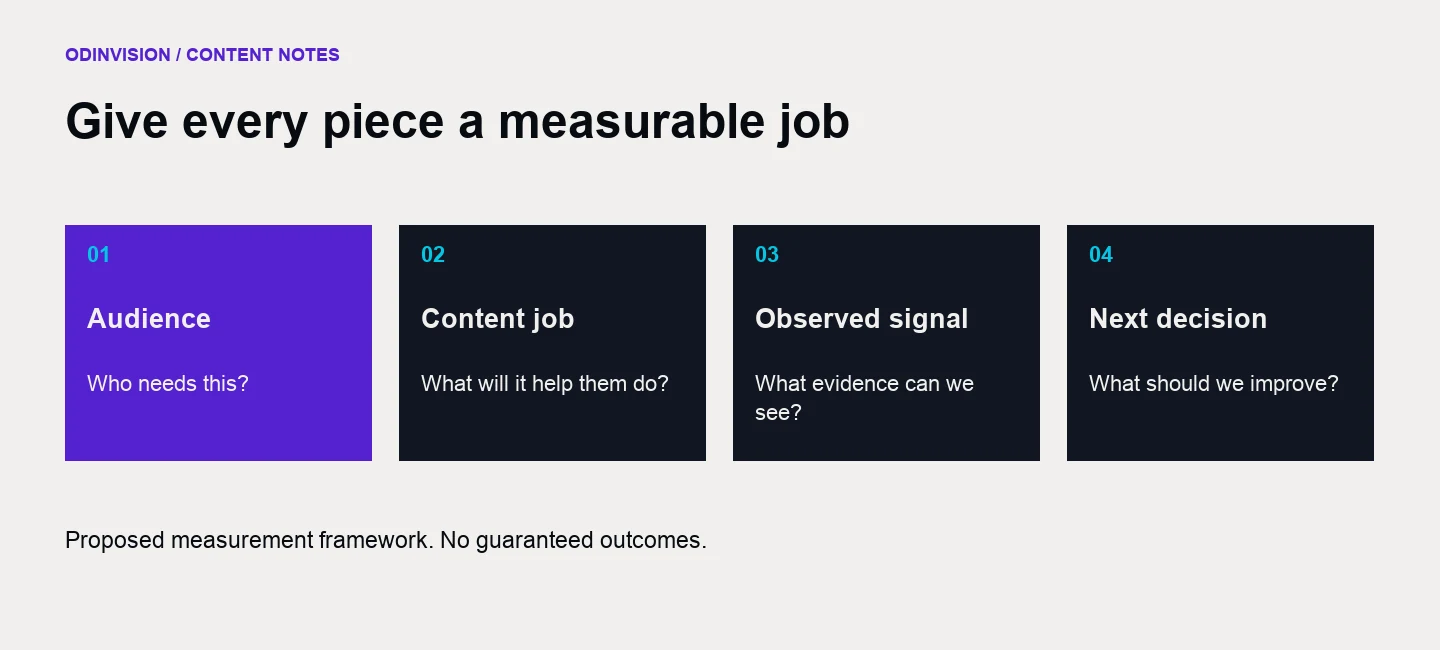
Build a scorecard you can actually use
Choose a primary goal for each piece and write down what evidence would help you judge it. The following is a suggested planning template:
| Content job | Useful signal | Decision the signal should inform |
|---|---|---|
| Explain a problem to new buyers | Relevant discovery and reading behaviour | Is the topic reaching the intended audience? |
| Help someone evaluate an approach | Specific questions and follow-up actions | Does the explanation resolve the decision? |
| Support a sales conversation | Sales usage and buyer feedback | What needs to be clearer or more complete? |
| Guide an existing customer | Resource use and task-related feedback | Does the guidance help them do the work? |
Establish a baseline, allow an appropriate review period and include the cost of research, production, distribution and internal review. Where revenue attribution is credible, use it. Where it is incomplete, say so and use the other evidence to improve decisions.
The next step is straightforward: choose one business goal, one audience and one question worth answering. Content becomes easier to evaluate when you know what success is supposed to look like.
See how OdinVision's Content OS works if you want a coordinated way to turn those questions into articles, visuals and other agreed formats.