


Your next useful article may already exist as a conversation your team has every week. A prospect asks why a project takes time. A customer misunderstands a process. A specialist explains a detail that changes how everyone thinks about the problem.
The knowledge is there. The task is to capture it, shape it into a useful story and choose the formats that help the right people understand it.
That is the starting point for a practical B2B content programme. You do not need a completely new idea for every channel. You do need to give each version a reason to exist.
Choose a question with enough substance
Start with a buyer question rather than a format quota. “We need four videos” leaves the hardest decision unresolved: what will those videos help someone understand?
A strong source topic has a clear audience, a meaningful decision and enough depth to support more than a slogan. It might explain why an approach fails, when to use one option over another, or what someone needs to prepare before starting a project.
For this article, consider an illustrative example: a B2B software consultancy wants to explain why migrating business data requires more than moving files. This is a fictional planning scenario, not an OdinVision customer case study.
The audience is an operations leader preparing for a migration. The useful argument is that the team needs to agree how fields, owners and exceptions will be handled before it treats the project as a transfer exercise. That gives the programme a specific subject and a practical purpose.
Capture the source before creating the formats
Speak with someone who understands the work. A focused conversation can surface details that a generic brief misses: which assumptions create problems, what customers tend to overlook, and where a decision changes the outcome.
For the migration example, useful prompts might include:
- What does a customer usually underestimate?
- Which decision needs to happen before the work begins?
- What is an example we can share without exposing customer information?
- When would the advice be different?
The source could also be an existing report, transcript, article or product document. Check its accuracy and permission to reuse it before treating it as the foundation of a new programme.
Turn the material into a short source brief containing the audience, central argument, supported facts and important qualifications. Note anything that still needs verification. A statement does not become more reliable because it appears in several formats.
Give each format a different job
Repurposing works best when you adapt the explanation to the setting. The Content Marketing Institute's guide to repurposing video describes it as a creative process of turning an idea into different media, rather than copying the same material everywhere.
For our illustrative migration topic, the content might take these forms:
| Format | Its job | Possible treatment |
|---|---|---|
| Substantial article | Explain the full decision | A guide to questions the team should resolve before migration |
| Landscape video | Make the process easier to picture | A narrated explanation of one field-mapping example |
| Short video | Resolve one misconception | Why matching column names is not enough |
| Social visual | Make a useful point easy to scan | A simple before-and-after field-mapping illustration |
| Sales follow-up resource | Prepare a specific conversation | A short checklist linked to the full guide |
This is an example mix, not a recommendation that every business needs all five. Choose formats you can distribute and maintain. A well-used article and diagram may be more valuable to your audience than a larger collection nobody has time to publish.
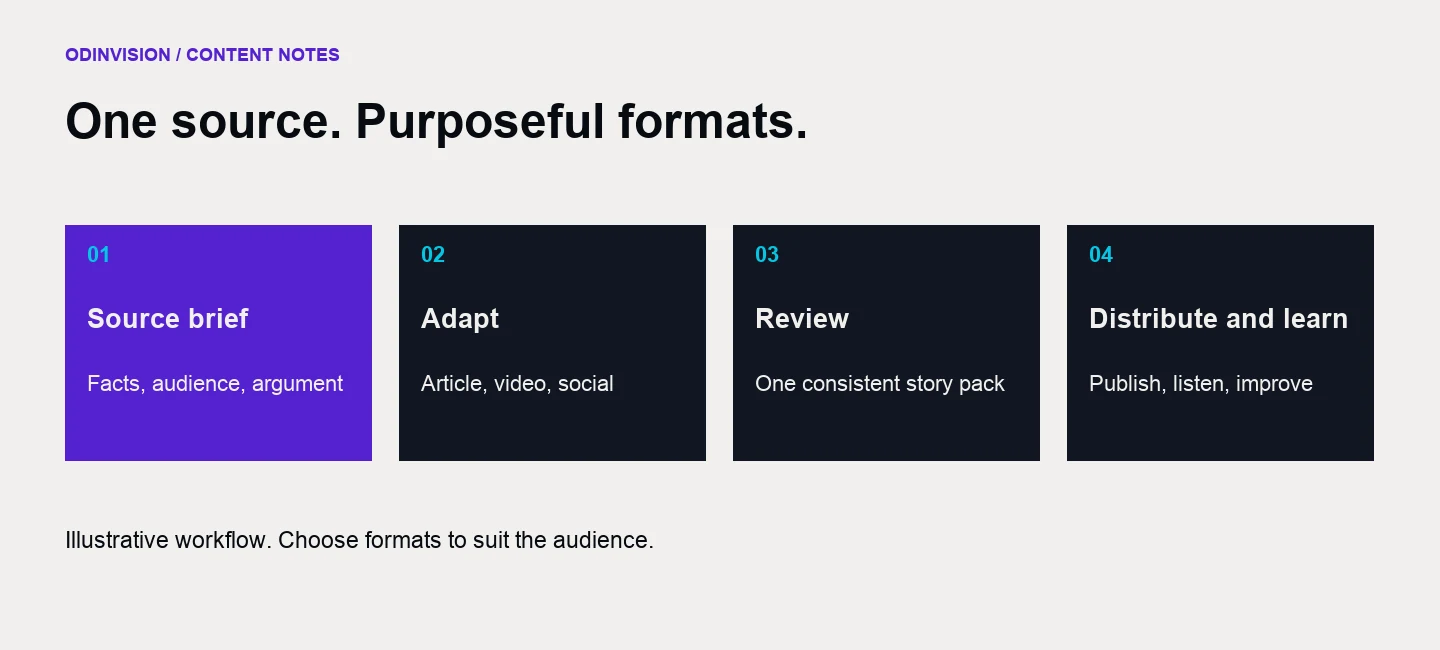
Adapt the content, including its context
A reader can pause, skim and return to a long article. A short video needs to establish its subject quickly. A diagram needs enough labelling to make sense without someone explaining it aloud.
Those differences change the writing. The video should not simply read the article's introduction. It might begin with the specific mistake the audience recognises, demonstrate one example and direct viewers to the full explanation when appropriate.
Likewise, a social graphic should not compress an entire article into tiny text. Give it one useful comparison or decision. Include essential qualifications in the asset or its immediate caption so that a detached screenshot does not reverse the meaning.
Keep the underlying facts consistent while changing the entry point. The same source can produce a broad explanation for an unfamiliar audience and a detailed checklist for someone already planning the work.
Use AI for drafts and adaptations, with accountable review
AI can be used to organise a transcript, propose an outline and draft alternative introductions. Those are sensible candidate tasks for a workflow because someone can check the output against a known source.
Treat the output as a draft. Check whether a summary dropped a qualification, whether a short script introduced a stronger claim, or whether a generated example sounds like a real customer story. Keep a knowledgeable person responsible for factual accuracy.
The broader evidence supports prioritising the content itself. In CMI's 2026 B2B research, 65% of marketers who rated their marketing effective identified content relevance and quality as contributing factors. That survey finding is not a test of any particular AI workflow. It reinforces a useful editorial question: does the finished piece help the audience?
Make approval a manageable piece of work
Give the reviewer a coherent pack. Include the article, scripts, visuals and a short list of claims that need specialist attention. Identify the approved source for any repeated number or statement.
Name one person to consolidate feedback. Otherwise, separate comments on separate formats can introduce contradictions: a correction reaches the article but never reaches the video caption.
Record the approved version and make related corrections across the pack. If the source advice changes later, you should be able to find the affected outputs. This is a practical reason to retain a simple content register with filenames, URLs, owners and review dates.
Plan distribution before production ends
Specify where each asset will appear, who will publish it, and what it should link to. Confirm that the selected channels suit your audience and that someone has access to the relevant accounts.
A possible first cycle is to publish the main guide, introduce its central problem through social content, then share a useful demonstration or checklist in the conversations where it belongs. Treat that as a starting hypothesis. Your audience's response should shape the next cycle.
Review more than output counts. Look at the questions the content attracts, whether the intended people use it, and which explanation seems to need further work. If a practical detail gets a strong response, explore that detail in the next piece instead of repeating the broad topic.
Build a rhythm around what your business knows
Start with one question, one reliable source and a format mix you can sustain. Complete the research and review, prepare the distribution, and learn from the result before expanding production.
OdinVision's Content OS follows this source-to-formats approach, developing conversations, articles, reports, transcripts or briefs into coordinated content for customer review. The mix depends on the plan; publishing, scheduling and community management are scoped separately.
A useful programme begins with something worth explaining. Give that idea the structure, evidence and formats it needs to reach the people it can help.