

Buyers, hires and partners read your content before they ever speak to you. Whatever they find is the opinion they walk in with. That is why B2B businesses are now expected to run like media brands: a blog that answers real questions, a LinkedIn page that shows how the company thinks, and short video on Instagram, TikTok and YouTube that explains the work in under a minute.
The category built around that expectation is very large. The work it demands is larger than most teams plan for. This article looks at both, and at why we built OdinVision to carry it.
A very large category
Content marketing is a very large market. Mordor Intelligence estimates the global content marketing market at USD 524.73 billion in 2025, rising to USD 989.84 billion by 2030. The same report puts video at 37.86% of the market by platform in 2024.
Inside B2B, content is close to universal. In the Content Marketing Institute's B2B Content and Marketing Trends: Insights for 2026, a survey of 1,015 B2B marketers, 97% said they have a content strategy.
Why buyers reward it
The case for doing it well is strong. In the 2024 Edelman-LinkedIn B2B Thought Leadership Impact Report, which surveyed 3,484 business executives across seven countries:
9 in 10 decision-makers and C-suite executives said they are more receptive to sales or marketing outreach from a company that consistently produces high-quality thought leadership.
73% of decision-makers said a company's thought leadership is a more trustworthy basis for judging its capabilities than its marketing materials and product sheets.
52% of decision-makers said they spend an hour or more each week reading thought leadership.
The same research shows the gap. Fewer than half of decision-makers said the thought leadership they read is good, and only 15% called it very good. Buyers are reading. Most of what they read does not earn their attention.
Two words in that first finding matter most: consistently and high-quality. Both are hard.
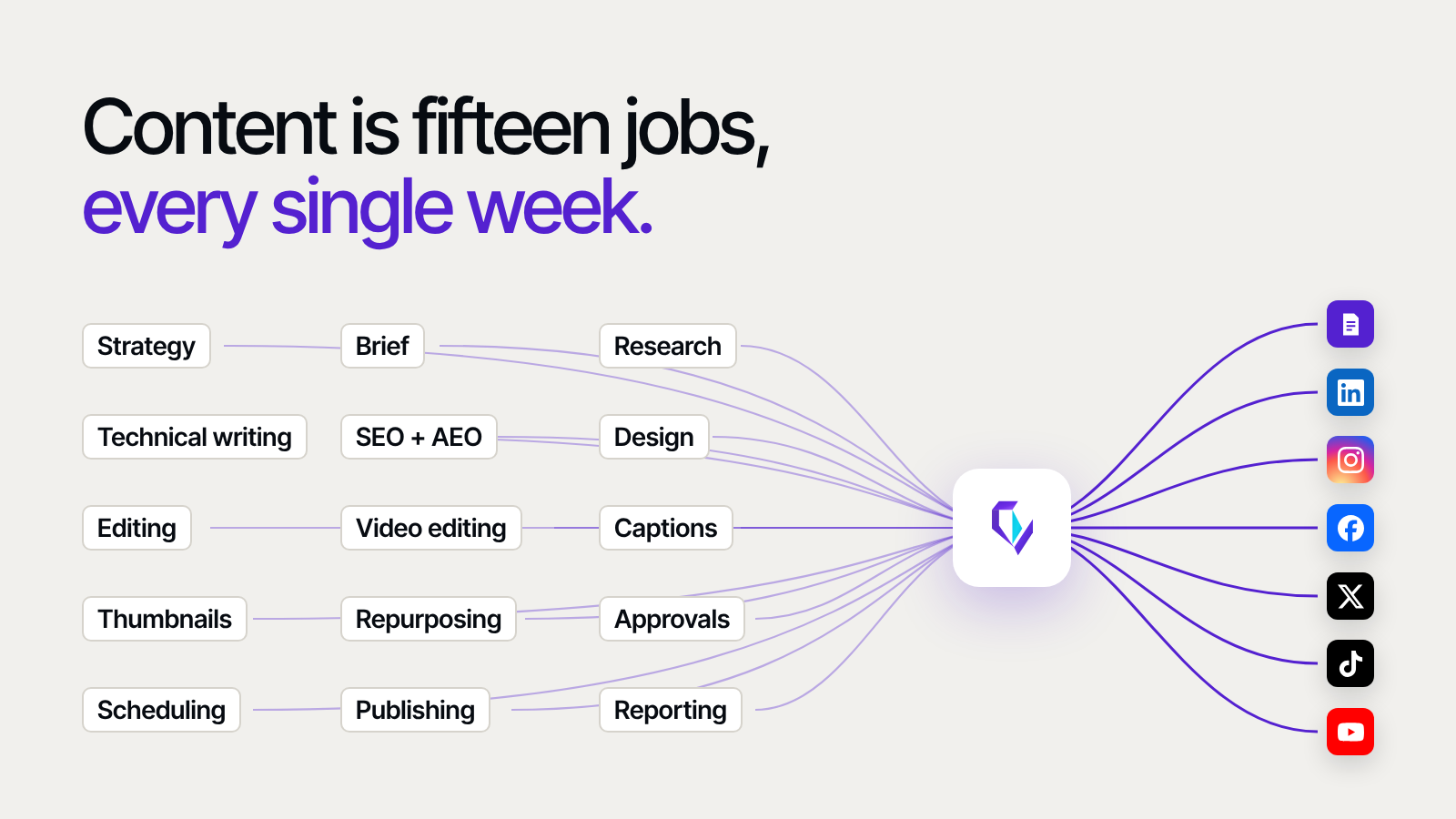
Content is fifteen jobs, every single week
From the outside, a good week of B2B content looks simple: an article, a few posts, a short video. Behind it sit fifteen separate jobs:
Strategy
Brief
Research
Technical writing
SEO and AEO
Design
Editing
Video editing
Captions
Thumbnails
Repurposing
Approvals
Scheduling
Publishing
Reporting
Then multiply by the channels. A blog post, a LinkedIn post, an Instagram Reel, a Facebook post, a post on X, a TikTok, a YouTube Short and a long-form YouTube film each need their own format, length, aspect ratio, caption and cover. The work repeats every week.
Where it breaks
Most companies try to cover those jobs with a mix of in-house staff, several agencies and a growing set of disconnected AI tools. The result is that the company becomes the project manager. Someone senior ends up chasing briefs, reconciling feedback and checking that the claim corrected in the article was also corrected in the video caption.
The research reflects this. In CMI's 2026 study, the top content marketing challenges were creating content that prompts a desired action (40%), resource constraints across time, people and budget (39%) and measuring content effectiveness (33%). A further 28% named creating enough quality content to meet their organisation's needs. Only 12% said their marketing exceeded its goals over the previous year.
The demand is there. The capacity to meet it, every week and on every channel, usually is not.
What the market is moving towards
Venture firm a16z has written about the same shift from the other side. In What is New Media?, its New Media team says that "Own your distribution" was once a radical idea in media, "But now it's just table stakes." It adds that growing a high-quality audience "takes craft, skill, and day-to-day persistence, to drive impressions up and to the right week after week."
In New Media, One Year In, the team describes its own work as "go-direct as a service" for startups, built on in-house video, design and editorial. It favours pairing long-form essays and conversations with short-form clips, and it is direct about volume: "you need quality and quantity. Writing one great essay every once in a while, or producing one charming video, isn't going to cut it."
Its enterprise team has made a related point about how this work is bought. In a December 2024 newsletter on pricing, it describes "software is becoming labor": services that once needed human labour, marketing among them, can now be "automated and packaged as software products."
Put together, the direction is clear. Companies need to publish consistently, on every channel, at a quality buyers respect. More of them want that delivered as a finished service rather than another tool to manage.
Why we built OdinVision
OdinVision turns that ecosystem into one managed system. Your team supplies the expertise. We research, write, design and edit the content for your channels.
It starts with one source a month: a conversation with your expert, an article, a report, a transcript or a focused brief. We shape it into a story and build every format from that one brief: articles for your blog, posts for LinkedIn, Instagram, Facebook and X, vertical video for TikTok, Reels and YouTube Shorts, and long-form films for YouTube.
Your part is two decisions. You choose the subject, and your named approver reviews the story pack. One set of comments lets us correct a claim everywhere it appears, and we make one consolidated round of revisions.
On the Growth plan, that means 4 articles, 4 films, 16 short clips and 28 social graphics every month, prepared for 72 placements across your channels.
We take on brands and tell their stories
For My Patient Advice, one published blog, "Are ADHD Kids Chronically Night-Owl?", became a narrated, captioned film. We read the blog, wrote the script and made the video. For Kitsune AI, OdinVision produced articles and a long-form film, "Pakistan's secret weapon in the AI race".
That is the work: take what a business already knows and make it travel, across every channel its buyers use.
One source. A month of content.
Sources
Mordor Intelligence, Content Marketing Market Size and Share Analysis (2025 to 2030)
Content Marketing Institute, B2B Content and Marketing Trends: Insights for 2026
LinkedIn and Edelman, 2024 B2B Thought Leadership Impact Report
a16z, AI Is Driving a Shift Towards Outcome-Based Pricing (19 December 2024)